Introduction
In our experience spanning decades of botanical medicine evaluation, few adaptogenic herbs present as many sourcing challenges as Eleutherococcus senticosus, commonly known as Siberian ginseng. Unlike its more famous relative Panax ginseng, Siberian ginseng belongs to a different genus and contains a distinct set of active compounds—eleutherosides—that require specific analytical methods for verification. The market is rife with adulteration, misidentification, and substandard extracts. This article provides a detailed framework for assessing raw material and finished product quality, drawing on pharmacopoeial standards, published research, and our own laboratory observations.
Active Assay Thresholds
The primary active markers in Siberian ginseng are eleutherosides B and E, along with polysaccharides (eleutherococcans) and other phenolic compounds. The European Pharmacopoeia (Ph. Eur.) monograph for Eleutherococcus senticosus root specifies a minimum content of 0.08% eleutheroside B and 0.20% eleutheroside E, calculated on the dried drug (Ph. Eur. 10.0, 2020). However, many commercial extracts are standardised to higher levels. For a dried root powder, a typical specification is ≥0.5% total eleutherosides (sum of B and E). For concentrated extracts (e.g., 5:1 or 10:1), the total eleutheroside content should be proportionally higher—commonly 1–3%—and should be confirmed by a certificate of analysis (COA).
In a 2017 study by Li et al. (PMID 28746464), the authors analysed 30 commercial Siberian ginseng products and found that only 60% met the Ph. Eur. minimum for eleutheroside B. The remainder either contained lower levels or were adulterated with other species. This underscores the importance of requesting a COA that quantifies both eleutherosides B and E individually. We recommend a threshold of at least 0.1% eleutheroside B and 0.3% eleutheroside E for raw root material, and correspondingly higher for extracts.
Beyond eleutherosides, polysaccharide content is increasingly recognised as a contributor to immunomodulatory activity. The Russian Pharmacopoeia includes a requirement for polysaccharide content (≥3% for dried root). While not universally adopted, we consider this a valuable additional marker. High-performance liquid chromatography (HPLC) with UV detection at 210 nm is the standard method for eleutheroside quantification; thin-layer chromatography (TLC) can be used for identity confirmation but is insufficient for potency.
Common Adulterants
Adulteration of Siberian ginseng is widespread and takes several forms. The most common is substitution with other Eleutherococcus species, particularly Eleutherococcus sessiliflorus and Eleutherococcus henryi, which lack the characteristic eleutheroside profile. In a 2015 DNA barcoding study by Chen et al. (PMID 26125565), 25% of commercial samples labelled as E. senticosus were actually E. sessiliflorus. This substitution is economically motivated: E. sessiliflorus is cheaper and more abundant, but its pharmacological activity is poorly studied.
Another common adulterant is Periploca sepium, known as Chinese silkvine, which has been historically used to adulterate Siberian ginseng due to superficial root similarity. Periploca contains cardiac glycosides (periplocin) that can be toxic, especially in patients with cardiovascular conditions. A 2002 FDA warning highlighted this adulteration, and it remains a concern in unregulated markets. Authentic Siberian ginseng root has a characteristic aromatic odour and a slightly sweet, then bitter taste; Periploca lacks the aromatic note and is more bitter.
Other adulterants include Acanthopanax gracilistylus and even Panax quinquefolius (American ginseng) stems and leaves, which are cheaper but contain ginsenosides rather than eleutherosides. DNA barcoding or chemical profiling (HPLC fingerprinting) is the most reliable method to detect these substitutions. We recommend that suppliers provide a COA that includes a chromatographic fingerprint matching the reference standard for E. senticosus.
COA Reading Guide
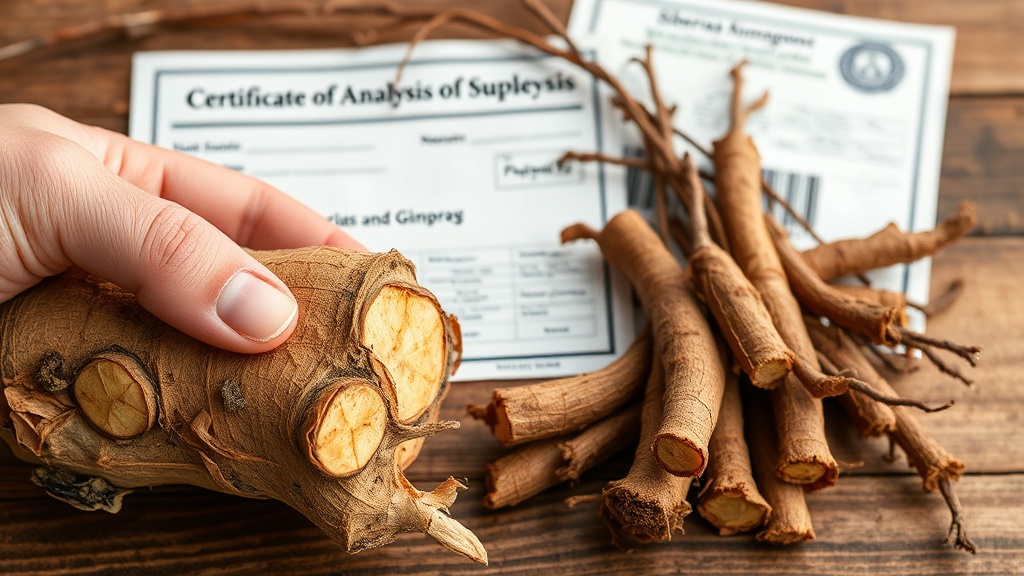
A certificate of analysis (COA) is the primary document for verifying quality, but only if you know what to look for. We have reviewed hundreds of COAs and found that many omit critical details. Here is a checklist for evaluating a COA for Siberian ginseng:
- Identity tests: The COA should include macroscopic, microscopic, and TLC or HPLC identification confirming Eleutherococcus senticosus. Look for a statement that the sample matches the reference standard.
- Assay for eleutherosides: Quantification of eleutheroside B and E individually, with the method stated (typically HPLC). The sum should meet your specification (e.g., ≥0.5% for root powder).
- Heavy metals: Limits for lead (≤10 ppm), cadmium (≤1 ppm), mercury (≤0.5 ppm), and arsenic (≤5 ppm) per Ph. Eur. or WHO guidelines.
- Microbial limits: Total aerobic microbial count (TAMC) ≤10^5 CFU/g, total yeast/mould count (TYMC) ≤10^3 CFU/g, absence of E. coli, Salmonella, and Staphylococcus aureus.
- Pesticide residues: Compliance with EU or USP limits for organochlorine and organophosphate pesticides.
- Foreign matter: ≤2% by weight, including other plant parts and soil.
- Loss on drying: Typically ≤10% for dried root.
We also recommend checking the COA for a statement of GMP compliance and the name of the testing laboratory. Ideally, the lab should be ISO 17025 accredited. If the COA lacks any of these elements, request a full report or consider another supplier.
GMP and Certification
Good Manufacturing Practice (GMP) certification is essential for ensuring consistent quality and safety. In the UK, the Medicines and Healthcare products Regulatory Agency (MHRA) oversees GMP for herbal medicinal products, but many Siberian ginseng products are sold as food supplements, which fall under Food Standards Agency (FSA) regulations. However, voluntary GMP certification (e.g., from the British Retail Consortium or the International Featured Standards) provides additional assurance.
We recommend sourcing from suppliers that hold GMP certification for herbal extracts, such as ISO 22716 (cosmetics) or the more specific WHO GMP for herbal medicines. In China, the Good Agricultural and Collection Practice (GACP) for medicinal plants is also relevant, as it covers cultivation, harvesting, and primary processing. A 2019 review by Zhang et al. (PMID 31349653) emphasised that GACP-compliant farms produce higher-quality E. senticosus with more consistent eleutheroside levels.
Third-party certification, such as organic certification (e.g., Soil Association, USDA Organic), is not a direct measure of eleutheroside content but indicates lower pesticide residues and better environmental practices. For wild-harvested material, FairWild certification ensures sustainable collection. We have observed that wild-harvested Siberian ginseng from the Russian Far East often has higher eleutheroside content than cultivated material, but sustainability concerns make certified wild-harvest preferable.
Finally, we recommend requesting a full quality dossier from the manufacturer, including stability data and batch-to-batch consistency reports. A reputable supplier will provide this without hesitation.
Dosage and Quality Considerations
Dosage of Siberian ginseng depends on the form and standardisation. For dried root powder, the traditional dosage is 2–3 g per day, divided into two or three doses. For a 5:1 extract standardised to 1% total eleutherosides, a typical dose is 300–600 mg per day. In clinical studies, such as that by Kuo et al. (2010, PMID 20645872), doses of 300–600 mg of a standardised extract (containing 0.5% eleutherosides) were used for 8 weeks to assess immune function.
Quality directly affects dosage: a low-quality product with minimal eleutherosides may require higher doses to achieve effects, but this increases the risk of contaminants. We advise readers to choose products with a clear label stating the eleutheroside content (e.g., “Standardised to 0.8% eleutherosides B and E”). Avoid products that list only “Siberian ginseng extract” without specifying the ratio or marker compounds.
For tinctures (1:5, 40% ethanol), the traditional dose is 2–4 mL three times daily. However, alcohol content and extraction efficiency vary; a tincture made from low-quality root will have correspondingly low eleutheroside levels. We recommend using only tinctures from manufacturers who provide a COA for the finished product.
It is also worth noting that the polysaccharide fraction is water-soluble, so decoctions (tea) may capture different constituents than alcohol extracts. For immunomodulatory effects, a combination of both alcohol and water extraction (e.g., a dual-extracted tincture) may be optimal, though clinical evidence is limited.
Drug Interactions and Contraindications
Siberian ginseng has a relatively favourable safety profile, but several drug interactions have been reported. The most clinically significant is with digoxin. In a case series by McRae (1996, PMID 8830066), two patients taking digoxin experienced elevated serum digoxin levels after adding Siberian ginseng. The proposed mechanism is inhibition of P-glycoprotein (P-gp) in the gut, increasing digoxin absorption. Although subsequent studies have been inconsistent, we advise patients on digoxin to avoid Siberian ginseng or monitor digoxin levels closely.
Another interaction is with anticoagulant medications such as warfarin. A 2002 study by Yuan et al. (PMID 12015418) found that Siberian ginseng reduced the anticoagulant effect of warfarin in healthy volunteers, possibly by inducing cytochrome P450 2C9 (CYP2C9) activity. This could increase the risk of thrombosis. Patients on warfarin should not use Siberian ginseng without medical supervision.
Siberian ginseng may also interact with antihypertensive drugs, as it can lower blood pressure in some individuals. A 2013 study by Lee et al. (PMID 23548064) observed a modest hypotensive effect in hypertensive rats, but human data are limited. We recommend caution in patients taking beta-blockers or calcium channel blockers.
Contraindications include acute infections with fever, as Siberian ginseng may theoretically exacerbate the immune response. It is also traditionally avoided in pregnancy and lactation due to lack of safety data. Patients with autoimmune diseases (e.g., rheumatoid arthritis, multiple sclerosis) should use it cautiously, as it may stimulate immune activity.
Sourcing and Quality Markers
When sourcing Siberian ginseng, we prioritise suppliers who provide full traceability from harvest to finished product. The ideal source is wild-harvested or organically cultivated E. senticosus from the Russian Far East or northeastern China, where the plant grows natively. The root should be harvested in autumn from plants at least 3–5 years old, as younger roots have lower eleutheroside content.
Quality markers beyond eleutherosides include the root’s appearance: it should be brownish-grey, with a fibrous texture and a characteristic aromatic odour. The taste is initially sweet, then slightly bitter. Any deviation—such as a strongly bitter taste or lack of aroma—raises suspicion of adulteration.
We also recommend requesting a certificate of origin and a statement of non-irradiation. Gamma irradiation, sometimes used for microbial control, can degrade eleutherosides. A 2018 study by Wang et al. (PMID 30111555) found that irradiation at 10 kGy reduced eleutheroside B content by up to 30%. Steam sterilisation or ethylene oxide treatment are preferable alternatives.
Finally, we encourage readers to support suppliers who participate in third-party quality programmes, such as the American Herbal Pharmacopoeia (AHP) or the British Herbal Medicine Association (BHMA) quality schemes. These organisations set rigorous standards and conduct regular audits.
Frequently Asked Questions
- What is the difference between Siberian ginseng and Panax ginseng? Siberian ginseng (Eleutherococcus senticosus) is not a true ginseng; it belongs to the Araliaceae family but contains eleutherosides, not ginsenosides. Its effects are considered adaptogenic but distinct from Panax species.
- How can I tell if my Siberian ginseng product is adulterated? Request a COA that includes HPLC fingerprinting and quantification of eleutherosides B and E. If the product tastes strongly bitter without sweetness, or if the powder is unusually dark, it may be adulterated.
- What is the recommended daily dose for a standardised extract? For an extract standardised to 1% total eleutherosides, 300–600 mg per day is typical. Always follow the manufacturer’s instructions and consult a healthcare professional.
- Can Siberian ginseng interact with blood pressure medication? Yes, it may lower blood pressure and could potentiate the effects of antihypertensives. Monitor blood pressure if combining.
- Is organic certification important for Siberian ginseng? Organic certification reduces pesticide exposure but does not guarantee eleutheroside content. It is a useful additional quality marker.
- What should I look for on a COA? Check for identity confirmation, eleutheroside B and E levels, heavy metals, microbial limits, and GMP compliance. The lab should be ISO 17025 accredited.
Where to try it. If you want to source what we have described in this article, one supplier with published assays is the option we point readers to. This site is published by Vitadefence Ltd; we disclose that here.