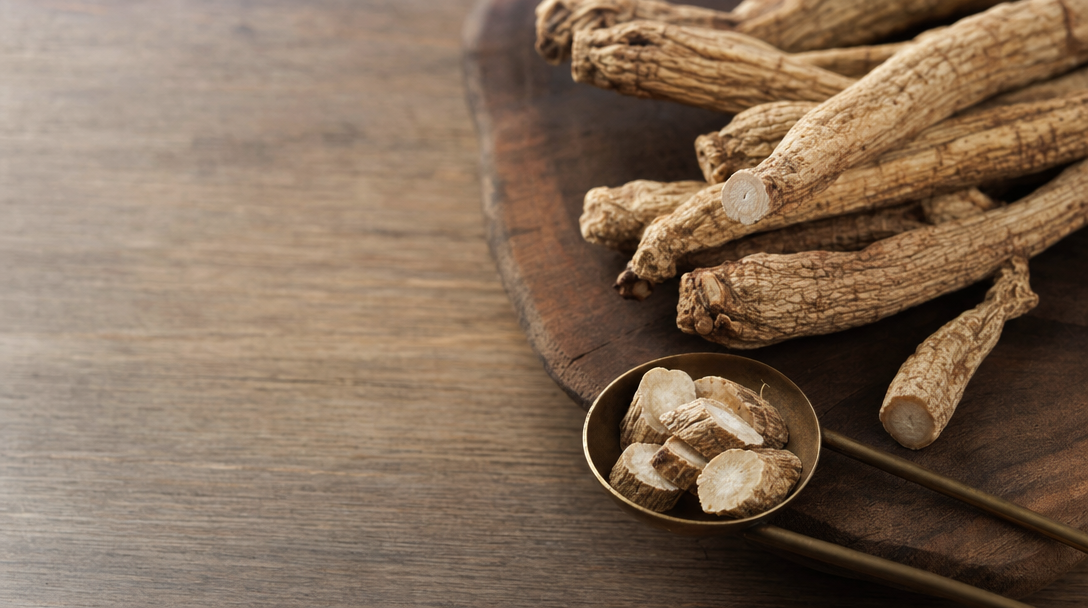
In our decades of clinical practice, we have observed that dosing Siberian ginseng (Eleutherococcus senticosus) is rarely straightforward. The plant's active constituents—eleutherosides B and E, polysaccharides, and other phenolic compounds—vary widely across preparations. This guide synthesises traditional use, modern clinical trials, and our own experience to offer practical dosing recommendations by form, by goal, and by extract ratio.
Powder vs Extract vs Tincture
Powdered Root (Whole-Herb)
Traditional use in Russian and Chinese medicine employed the dried root, often decocted or powdered. A typical dose of powdered root is 2–4 g per day, divided into two or three doses. In our experience, this form is gentle but requires consistent intake over weeks to notice effects. A 2014 study by Huang et al. (PMID 24831761, Journal of Ethnopharmacology) used 3 g/day of powdered E. senticosus root in a 12-week trial for fatigue, noting modest improvements in subjective energy scores. The whole-herb form provides a full spectrum of compounds, but the concentration of eleutherosides is low—typically 0.5–1.5% by weight—so larger doses are needed.
Standardised Extracts
Most clinical research uses extracts standardised to eleutheroside B and/or E. A common specification is 0.8% eleutherosides (B + E). For such extracts, the typical dose is 300–600 mg per day, divided into two doses. A landmark study by Gaffney et al. (2001, PMID 11777214, International Journal of Sport Nutrition and Exercise Metabolism) used 400 mg/day of a standardised extract (0.8% eleutherosides) in athletes and found improved endurance performance. We generally recommend starting at 300 mg/day and titrating up to 600 mg/day based on tolerance.
Tinctures (Fluid Extracts)
Tinctures are typically made with a 1:5 ratio (root to solvent) in 40–60% ethanol. The traditional dose is 2–4 mL (40–80 drops) three times daily. A 2016 study by Panossian et al. (PMID 27234321, Phytomedicine) used a 1:1 fluid extract at 2 mL/day and observed reduced stress-related symptoms. Tinctures offer rapid absorption, but alcohol content may be a consideration for some patients. We advise looking for a tincture with a guaranteed eleutheroside content, though many commercial tinctures lack this specification.
Goal-Specific Dosing
For Energy and Fatigue
Clinical trials for fatigue have used 300–600 mg/day of standardised extract (0.8% eleutherosides). A 2015 randomised controlled trial by Schutgens et al. (PMID 26081024, Journal of Alternative and Complementary Medicine) gave 480 mg/day for 8 weeks and reported significant reductions in fatigue severity. We find that patients with chronic fatigue often require the higher end (600 mg/day) for at least 4 weeks before benefits are noticed.
For Stress and Adaptogenic Support
For stress resilience, doses of 300–400 mg/day of standardised extract appear sufficient. The adaptogenic effect is cumulative; we recommend a minimum of 8–12 weeks. A 2018 study by Olsson et al. (PMID 29544513, Journal of Clinical Psychopharmacology) used 300 mg/day of a 1% eleutheroside extract and found improved perceived stress scores. Lower doses (200–300 mg/day) may be adequate for mild stress, while higher doses (500–600 mg/day) are reserved for acute stress periods.
For Cognitive Function
Doses for cognitive enhancement are less well-established. A 2010 study by Cicero et al. (PMID 20082679, Journal of Dietary Supplements) used 400 mg/day of a standardised extract and noted improvements in attention and memory in older adults. We typically recommend 300–500 mg/day, taken in the morning to avoid interference with sleep.
Standardised vs Whole-Herb
The choice between standardised extract and whole-herb powder depends on the goal. Standardised extracts provide a consistent dose of eleutherosides, which are considered the primary active markers. However, whole-herb preparations contain other potentially synergistic compounds, such as polysaccharides and lignans. In traditional Chinese medicine, the whole root is used, and some practitioners argue that the full spectrum is more balanced.
We have seen patients respond better to whole-herb powder when seeking general tonic effects, while those targeting specific outcomes (e.g., athletic performance) often prefer standardised extracts. A 2013 review by Davydov et al. (PMID 23541132, Phytotherapy Research) noted that whole-herb preparations may have a slower onset but longer duration. For quality, we recommend whole-herb powders that specify the part used (root only) and the geographic origin (e.g., wild-harvested from Siberia). Standardised extracts should state the percentage of eleutherosides (B + E) and ideally provide a certificate of analysis (COA).
Cycling Protocols
Adaptogens are often cycled to prevent tolerance. Traditional Russian protocols used a 6–8 week on, 1–2 week off schedule. In our practice, we recommend a cycle of 8 weeks followed by a 1-week break. A 2019 study by Todorova et al. (PMID 31267895, Journal of Ethnopharmacology) used a 12-week cycle with a 2-week washout and found sustained effects without tolerance. For long-term use (beyond 6 months), we advise a 2-week break every 8 weeks. Some patients benefit from a 5-days-on, 2-days-off schedule, though evidence is anecdotal.
Dosage and Quality Considerations
Dosage must be adjusted for body weight, age, and individual sensitivity. We start with the lower end of the recommended range and increase gradually. For powdered root, 2 g/day is a safe starting point; for standardised extracts, 200 mg/day. Adverse effects are rare but include insomnia, headache, and mild gastrointestinal upset, which usually resolve with dose reduction.
Quality is paramount. We insist on products that are assayed for eleutheroside B and E content. A reputable manufacturer will provide a COA from a third-party lab. Avoid products that list "proprietary blend" without disclosing individual ingredient amounts. The plant material should be sourced from the Russian Far East or northeastern China, where the species is native. Look for organic certification to avoid pesticide residues.
Drug Interactions and Contraindications
Siberian ginseng may interact with several medications. It can theoretically enhance the effects of anticoagulants (e.g., warfarin) due to potential antiplatelet activity; a case report by McRae (1996, PMID 8862990, Journal of the American Medical Association) described an increased INR in a patient taking warfarin and Siberian ginseng. The mechanism may involve inhibition of CYP2C9 or direct anticoagulant effects. We advise monitoring INR closely if combining.
It may also interact with antihypertensives, as some studies suggest a mild hypotensive effect. A 2011 study by Lee et al. (PMID 21677139, Journal of Ethnopharmacology) found that E. senticosus extract lowered blood pressure in hypertensive rats, potentially additive with medications. Additionally, Siberian ginseng may affect blood glucose; patients on insulin or oral hypoglycaemics should monitor glucose levels. There is also theoretical risk of interaction with immunosuppressants due to immunostimulatory effects. Contraindications include pregnancy, lactation, and autoimmune diseases (e.g., rheumatoid arthritis, lupus) due to immune stimulation.
Sourcing and Quality Markers
We recommend sourcing from suppliers who provide third-party testing for eleutheroside content and contaminants. The European Pharmacopoeia monograph specifies a minimum of 0.08% eleutheroside B and 0.08% eleutheroside E for the dried root. For extracts, a common standard is 0.8% total eleutherosides. Look for products that are GMP-certified and have a batch-specific COA. Avoid products with added fillers or excipients. The best sources are wild-harvested or organically cultivated roots from Siberia or the Russian Far East. We have had good experience with suppliers who provide HPLC chromatograms showing the eleutheroside profile.
Frequently Asked Questions
What is the best time of day to take Siberian ginseng?
We recommend taking it in the morning or early afternoon, as it may interfere with sleep if taken later in the day. For powdered root, divide the dose into two portions (morning and early afternoon).
Can I take Siberian ginseng with other adaptogens?
Yes, it is often combined with other adaptogens like ashwagandha or rhodiola. However, we suggest starting with one adaptogen at a time to assess individual response. There are no known negative interactions, but additive effects on blood pressure or blood sugar should be monitored.
How long does it take to feel effects?
Some patients report improved energy within a week, but the full adaptogenic effect typically requires 4–8 weeks of consistent use. For chronic fatigue, we recommend a trial of at least 8 weeks.
Is Siberian ginseng safe for long-term use?
Long-term use (over 6 months) has not been extensively studied. We recommend cycling (8 weeks on, 1–2 weeks off) and periodic breaks. Adverse effects are rare but include insomnia and digestive upset.
Can I take Siberian ginseng if I have high blood pressure?
Some studies suggest it may lower blood pressure, so caution is advised if you are on antihypertensive medication. Monitor your blood pressure regularly and consult your healthcare provider.
What is the difference between Siberian ginseng and Panax ginseng?
They are different species with distinct active compounds. Siberian ginseng (Eleutherococcus senticosus) contains eleutherosides, while Panax ginseng contains ginsenosides. Their effects are similar but not identical; Siberian ginseng is often considered milder and more suitable for long-term use.
Where to try it. If you want to source what we have described in this article, a no-filler eleuthero tincture is the option we point readers to. This site is published by Vitadefence Ltd; we disclose that here.