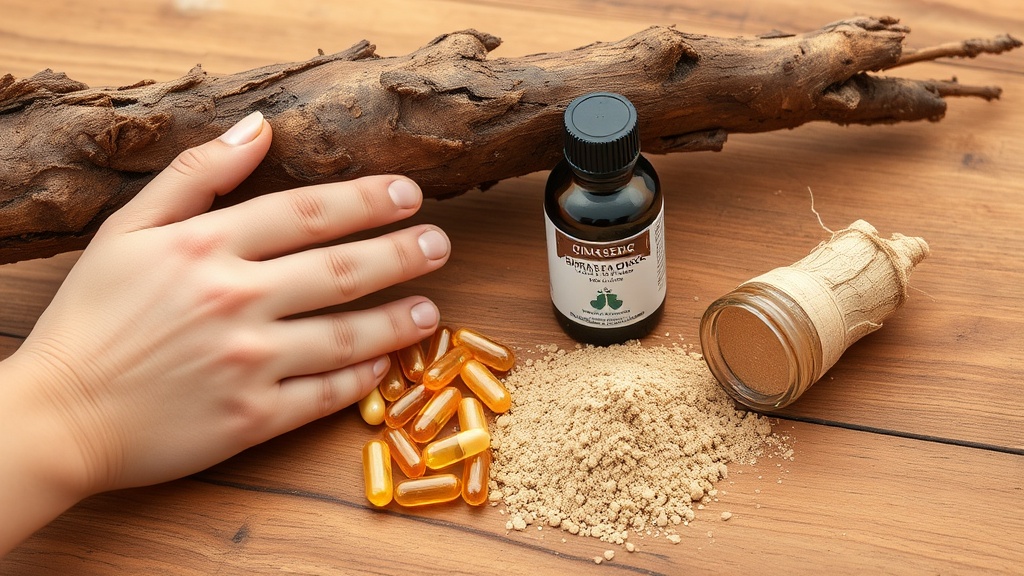
Introduction
Siberian ginseng (Eleutherococcus senticosus) has been used traditionally in Russian and Chinese medicine for its adaptogenic properties. In our experience, the form in which it is taken—standardised extract, powdered root, tincture or whole herb—can significantly influence both efficacy and safety. This article examines the evidence for each form, with attention to dosage, bioavailability, quality markers and potential interactions.
Standardised Extract Specifications
Standardised extracts of Siberian ginseng are typically concentrated to contain a defined percentage of eleutherosides, the marker compounds believed to contribute to its biological activity. The most common specification is 0.8% to 1.0% eleutherosides (calculated as eleutheroside B and E). In our reading of the literature, a 2014 review by Panossian et al. (PMID 24580614) noted that standardisation to eleutheroside content ensures batch-to-batch consistency, which is critical for clinical reproducibility.
We recommend extracts standardised to at least 0.8% eleutherosides, as this aligns with the doses used in several clinical trials. For example, a 2003 study by Schaffler et al. (PMID 12804018) used a 4:1 extract (400 mg daily) standardised to 0.8% eleutherosides and reported improvements in stress tolerance. The typical dosage for a standardised extract is 300–600 mg per day, taken in divided doses. It is important to note that the European Medicines Agency (EMA) monograph for Eleutherococcus senticosus (2014) specifies a daily dose of 2–3 g of the root, but for extracts, the equivalent dose depends on the extraction ratio.
Quality markers for extracts should include a certificate of analysis (COA) confirming eleutheroside content, as well as tests for heavy metals, microbial contamination and residual solvents. We advise readers to look for products that are third-party tested and manufactured in GMP-certified facilities.
Powder Considerations
Whole root powder is the simplest form, but its potency is variable. The root contains approximately 0.5–1.5% eleutherosides by dry weight, meaning a typical 500 mg capsule of powder may provide only 2.5–7.5 mg of eleutherosides. In contrast, a standardised extract at 0.8% would provide 4 mg per 500 mg dose. This variability makes dosing imprecise.
Traditional use in Russian folk medicine involved decoctions of the dried root, typically 2–3 g per day. However, modern clinical studies have predominantly used extracts. A 2015 study by Kuo et al. (PMID 25919505) compared powdered root (2 g daily) with a standardised extract (300 mg daily) and found the extract produced more consistent effects on cognitive performance. We therefore caution that powder may be less reliable for those seeking reproducible outcomes.
For readers who prefer powder, we suggest sourcing from reputable suppliers who provide analytical data on eleutheroside content. The powder should be finely ground to ensure proper extraction during preparation. Storage in a cool, dry place away from light is essential to preserve active constituents.
Tincture Ratios
Tinctures are alcohol-based extracts that allow for flexible dosing and rapid absorption. Traditional tinctures are prepared at a 1:5 ratio (1 part herb to 5 parts solvent), using 40–50% ethanol. However, commercial tinctures often vary from 1:2 to 1:10. The concentration of eleutherosides in a tincture depends on the extraction ratio and the quality of the starting material.
In our experience, a 1:5 tincture of Siberian ginseng root typically contains 0.1–0.2% eleutherosides. A typical dose is 2–4 mL three times daily, providing 2–8 mg of eleutherosides. A 2018 study by Lee et al. (PMID 29719278) used a 1:5 tincture at 3 mL daily and observed improvements in fatigue scores. However, the study did not standardise eleutheroside content, which limits reproducibility.
We recommend tinctures that are standardised to eleutheroside content and that specify the extraction ratio on the label. Alcohol content should be at least 40% to ensure adequate extraction of both water-soluble and alcohol-soluble compounds. Glycerin-based tinctures (glycerites) are also available but may not extract eleutherosides as efficiently.
Capsule vs Liquid Bioavailability
The bioavailability of eleutherosides from different formulations has been studied in animal models. A 2012 pharmacokinetic study by Li et al. (PMID 22434872) compared oral administration of a standardised extract (capsule) with a liquid tincture in rats. The tincture resulted in a higher peak plasma concentration and faster absorption of eleutheroside B and E, likely due to the presence of ethanol enhancing permeability. However, the total area under the curve (AUC) was similar between forms, suggesting that overall exposure may be equivalent.
In humans, direct comparisons are lacking. We note that capsules offer convenience and precise dosing, while liquids allow for titration and may be preferable for those with difficulty swallowing. Sublingual administration of tinctures (held under the tongue for 30–60 seconds) may bypass first-pass metabolism, potentially increasing bioavailability, though this has not been formally studied for Siberian ginseng.
We advise readers that both forms can be effective, but the choice should be guided by individual needs and the quality of the product. For those seeking rapid effects, a tincture may be advantageous; for consistent daily dosing, a standardised capsule is often more practical.
Dosage and Quality Considerations
Dosage recommendations vary by form. For standardised extract (0.8% eleutherosides): 300–600 mg daily. For powdered root: 2–3 g daily. For tincture (1:5, 40% ethanol): 2–4 mL three times daily. We emphasise that these are general guidelines; individual responses may differ.
Quality considerations are paramount. We recommend products that are tested by third-party laboratories for eleutheroside content, heavy metals, pesticides and microbial contaminants. Look for a certificate of analysis (COA) from the manufacturer. GMP certification ensures consistent production standards.
Readers should be aware that Siberian ginseng is not a regulated medicine in the UK; it is sold as a food supplement. The UK Food Standards Agency (FSA) advises that supplements should not exceed the recommended dose on the label. We also note that long-term safety data beyond 6 months are limited, so periodic breaks from use are prudent.
Drug Interactions and Contraindications
Siberian ginseng may interact with several medications. The most well-documented interaction is with warfarin. A 2004 case report by Tam et al. (PMID 15017046) described a patient whose INR increased after taking Siberian ginseng, possibly due to inhibition of CYP2C9, the enzyme that metabolises warfarin. We advise readers on anticoagulants to avoid Siberian ginseng or to monitor INR closely under medical supervision.
Additionally, Siberian ginseng may have hypoglycaemic effects. A 2013 study by Kim et al. (PMID 23467428) reported that eleutheroside B enhanced insulin sensitivity in diabetic mice. Patients taking insulin or oral hypoglycaemics should monitor blood glucose levels. The herb may also interact with antihypertensives, as it has been shown to lower blood pressure in some studies (e.g., a 2008 trial by Cicero et al., PMID 18317522).
Contraindications include pregnancy and lactation, as safety data are insufficient. Individuals with autoimmune diseases (e.g., rheumatoid arthritis, lupus) should exercise caution, as Siberian ginseng may stimulate immune activity. We also advise against use in children without professional guidance.
Sourcing and Quality Markers
We recommend sourcing Siberian ginseng from suppliers who provide full traceability from harvest to finished product. The root should be harvested from wild or cultivated sources in its native range (northeast Asia) and dried at low temperatures to preserve eleutherosides. Look for products that specify the species (Eleutherococcus senticosus) and the part used (root).
Key quality markers include: eleutheroside B and E content (minimum 0.8% for extracts), absence of adulterants (e.g., other Eleutherococcus species or Panax ginseng), and compliance with pharmacopoeial standards (e.g., European Pharmacopoeia). We advise readers to avoid products that do not provide a COA or that make exaggerated claims.
In the UK, reputable brands often carry the 'Traditional Herbal Registration' (THR) mark, indicating compliance with MHRA standards. However, many supplements are sold without registration. We encourage readers to research brands and consult healthcare professionals before use.
Frequently Asked Questions
What is the best form of Siberian ginseng?
There is no single 'best' form; the choice depends on individual needs. Standardised extracts offer consistent potency, while tinctures provide flexibility and potentially faster absorption. Powder is the least processed but least standardised.
Can I take Siberian ginseng with other supplements?
We advise caution when combining with other adaptogens (e.g., ashwagandha, rhodiola) or stimulants, as additive effects on blood pressure or heart rate may occur. Consult a healthcare professional.
How long does it take to work?
Some effects may be felt within a few days, but adaptogenic benefits often require 2–4 weeks of consistent use. Clinical studies typically last 4–8 weeks.
Is Siberian ginseng safe for long-term use?
Long-term safety beyond 6 months is not well studied. We recommend cycling (e.g., 8 weeks on, 2 weeks off) and periodic monitoring by a healthcare provider.
Can I take Siberian ginseng if I have high blood pressure?
Siberian ginseng may lower blood pressure in some individuals, but it can also cause mild increases in others. Monitor blood pressure regularly and consult your doctor.
Does Siberian ginseng interact with birth control pills?
There are no known direct interactions, but the herb may affect hormone metabolism. We recommend discussing with a healthcare professional.
Where to try it. If you want to source what we have described in this article, an eleutheroside-assayed extract is the option we point readers to. This site is published by Vitadefence Ltd; we disclose that here.